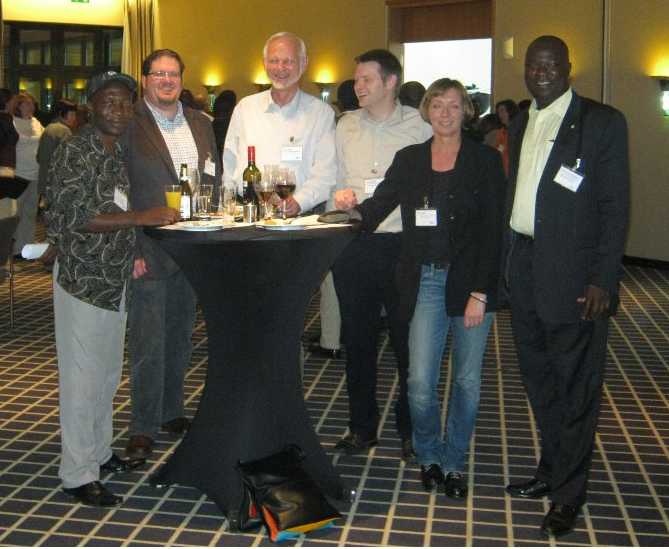
Prof. Daniel Achukwi from IRAD Wakwa is now in Germany to evaluate serum samples from the project cattle herd. He is following training in parasitological, immunological and molecular biology methods at the Tübingen University and the Bernhard-Nocht-Institute in Hamburg.
https://www.river-blindness.com/wp-content/uploads/2017/12/Programme-Onchocercoses-Logo.png00website administratorhttps://www.river-blindness.com/wp-content/uploads/2017/12/Programme-Onchocercoses-Logo.pngwebsite administrator2011-08-05 07:22:202011-08-05 07:22:20Project partner Daniel Achukwi in Germany
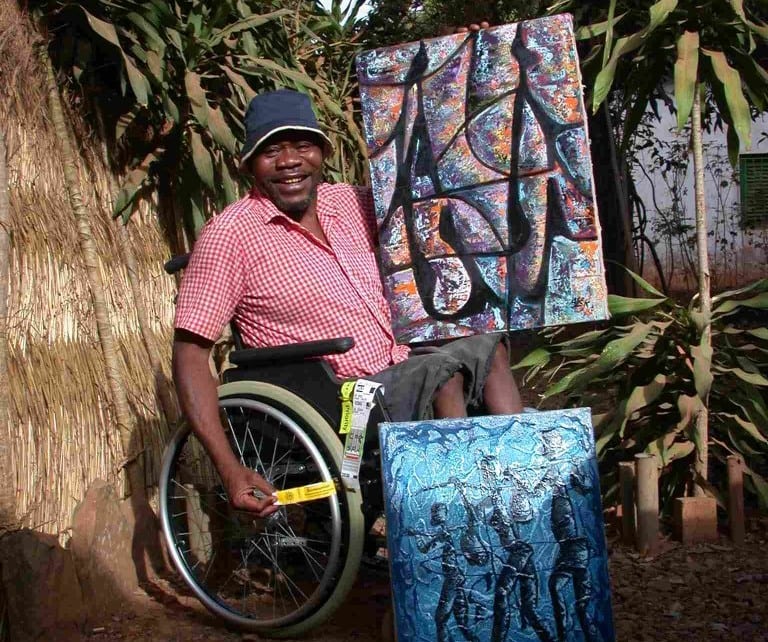
These photos show Issek, a Cameroonian artist receiving his new wheelchair. A big thank you to Dr. Irmgard Schreier from Tübingen, Germany for donating the wheelchair and Air France for priority transportation of the chair.
Issek is an artist based in Cameroon. He designed the logo for Programme Onchocercoses with Dr. Renz.
https://www.river-blindness.com/wp-content/uploads/2011/11/DSCN3048-768x1024-e1364893912705.jpg642768website administratorhttps://www.river-blindness.com/wp-content/uploads/2017/12/Programme-Onchocercoses-Logo.pngwebsite administrator2011-03-15 11:03:032013-04-07 20:39:31Issek’s New Wheel Chair
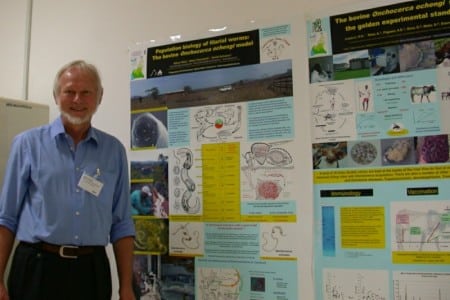
DFG-Meeting in Accra, Ghana, 23rd – 27th of March 2011.
The second meeting of German-African research partners in Accra brought together more than 25 research projects. Our work was presented by an oral talk and 5 posters.
https://www.river-blindness.com/wp-content/uploads/2011/11/Posters-Accra-DFG-Meeting-2.2011-1-Renz-Maerz-2011-komp.335-450x3002.jpg300450website administratorhttps://www.river-blindness.com/wp-content/uploads/2017/12/Programme-Onchocercoses-Logo.pngwebsite administrator2011-02-27 22:16:422012-01-18 22:02:26DFG-meeting in Accra, Ghana for 23-27th of March 2011.
Julia Hildebrandt, MPI, awarded the EvE Förderpreis für Evolutionsbiology for her studies on molecular genetics of Onchocerca ochengi. For more information, please click here.
https://www.river-blindness.com/wp-content/uploads/2017/12/Programme-Onchocercoses-Logo.png00website administratorhttps://www.river-blindness.com/wp-content/uploads/2017/12/Programme-Onchocercoses-Logo.pngwebsite administrator2011-02-27 22:00:282013-04-02 09:04:29EvE Förderpreis für Evolutionsbiology
DAAD-grant received for Stephanie in November 2010
Starting in January 2012, they will stay for 2 (or three months) in Cameroon to work in our project and to collect data for the thesis of diploma. Their work shall focus on the population biology of Onchocerca worms and their arthropod vectors.
This is likely for the first time that you see a microfilaria moving in its natural way, as it wanders through the skin. It was made posible by embedding the living microfilariae in a medium soft enough to allow movement and strong enough to provide a solid ground for its movements. One can see how it uses its tail to move ahead. Any macrophages etc. trying to attack on its cuticula, can easily be sweeped off.
In most cases one sees a living microfilaria, it is in a drop of saline, and the microfilaria moves on the spot by helpless wrigglings, but without making any distance.
https://www.river-blindness.com/wp-content/uploads/2017/12/Programme-Onchocercoses-Logo.png00website administratorhttps://www.river-blindness.com/wp-content/uploads/2017/12/Programme-Onchocercoses-Logo.pngwebsite administrator2010-10-11 18:54:122013-04-02 09:57:13Video of a moving Onchocerca ochengi microfilaria
Am Donnerstag, den 14. Oktober berichtet Albert im Zoologischen Kolloquium über seine Arbeit in Kamerun: “Charakterisierung der Filarien des Zebu-Rindes in Zentralafrika, sowie deren Vektoren mittels morphologischer, genetischer und epizootiologischer Analyse” Im Hörsaal E3A07 im E-Bau (Zoologie); Auf der Morgenstelle: 9.15-10.00 Uhr
Gäste herzlich willkommen!
https://www.river-blindness.com/wp-content/uploads/2017/12/Programme-Onchocercoses-Logo.png00website administratorhttps://www.river-blindness.com/wp-content/uploads/2017/12/Programme-Onchocercoses-Logo.pngwebsite administrator2010-10-11 17:19:262013-04-02 09:58:53Vortrag Albert Eisenbarth
David Ekale has been trained as a laboratory assistant in our various research projects since 1984. He is now a part-time student in Nsukka, Nigeria and reports of his experiences there.
During wor work with the Programme Onchocercoses in Cameroon (1984 to 1987 in Kumba, then in Ngaoundere) I learned many entomological and parasitological techniques, like dissections of Simulim damnosum flies, morphometric description of adult flies, identification of third stage larvae and microfilaria species. cryopreservation of microfilaria species, intra-thoracic injection of microfilaria in vector flies, cytotaxonomy of the Simulium damnosum complex, embryogram analysis etc. To enlarge my scientific background and to learn more about biology and research methods, I inscribed as a part-time student at the Nsukka-University in Nigeria. Here are my impressions as a student of an African university:
My experience in Nigeria
My study destination Nigeria is a huge country with over 150 million inhabitants. Amazing indeed, because despite the huge oil deposits making it one of the richest country in Africa it is still rated a poor country with less than a dollar per person per day; problems arising mainly from leadership style, poor management and especially corruption has a negative impact in the country’s economy. It is like a magnified version of what is happening in most African countries.
Die Entwicklung von neuen medizinischen Therapieformen für Armutskrankheiten. So sollen im Mittelpunkt vor allem solche Krankheiten stehen, deren Erforschung bislang – zumeist aus wirtschaftlichen Gründen – vernachlässigt wurde. Die Projekte sollen den Wissenschaftlerinnen und Wissenschaftlern Forschungsmöglichkeiten erschließen, die ein Partner für sich allein nicht hätte.
Unter dem Stichwort „capacity building” sollen mit der Etablierung hervorragender wissenschaftlicher Infrastruktur die akademischen Bedingungen in Afrika gestärkt werden.
Erklärtes Programmziel ist es, den jungen afrikanischen Wissenschaftlerinnen und Wissenschaftlern mit einer hochwertigen Ausbildung eine langfristige Perspektive im Heimatland zu ermöglichen. Besonderes Augenmerk wurde bei der Bewilligung der Kooperationsprojekte daher auf die wissenschaftliche Nachwuchsförderung gelegt. In Kombination mit der verbesserten Infrastruktur soll damit dem „brain drain”-Effekt entgegengetreten werden.
Nicht nur der Austausch innerhalb einer Projektgemeinschaft soll gefördert werden: Von Bedeutung ist die umfassende Vernetzung aller Wissenschaftlerinnen und Wissenschaftler, die an deutsch-afrikanischen Kooperationen beteiligt sind.
Insbesondere vor dem Hintergrund des Austauschs ist nun das Auftakt-Treffen in Berlin initiiert und gestaltet worden. Neben den Fachvorträgen gehört auch ein Besuch der gemeinsam von DFG und Robert Koch-Institut entwickelten Ausstellung „MenschMikrobe – Das Erbe Robert Kochs und die moderne Infektionsforschung” zum Programm. Im Anschluss daran findet am Dienstag, 22. Juni 2010, um 18 Uhr im Thaer-Saal der Humboldt-Universität, Invalidenstraße 42, 10115 Berlin, eine Podiumsdiskussion in englischer Sprache zum Thema „Armutskrankheiten in Afrika” statt.
Die afrikanischen Kooperationspartner sind in Äthiopien, der Demokratischen Republik Kongo, Elfenbeinküste, Gabun, Ghana, Kamerun, Kenia, Mosambik, Namibia, Nigeria, Sambia, Sudan, Südafrika, Tansania, Tunesien und Uganda angesiedelt. Die Laufzeit der Projekte soll bis zu acht Jahren betragen – mit zwei Zwischenbegutachtungen nach jeweils drei Jahren.
Journalisten sind zur Podiumsdiskussion herzlich eingeladen.
Um Anmeldung bei Michael Hönscheid wird gebeten:
E-Mail: Michael.Hoenscheid(at)dfg.de
Tel.: 0228 – 885 – 2109
Kontakt
Dr. Andreas Strecker
Tel.: 0228 – 885 – 2530
E-Mail: Andreas.Strecker(at)dfg.de
Quelle: Deutsche Forschungsgemeinschaft DFG
Weitere Informationen
Einrichtungen
Deutsche Forschungsgemeinschaft (DFG)
00website administratorhttps://www.river-blindness.com/wp-content/uploads/2017/12/Programme-Onchocercoses-Logo.pngwebsite administrator2010-06-28 15:08:312012-12-10 17:35:12DFG Meeting in Berlin
Onchocerca volvulus, the causative agent of river blindness, is transmitted through the black fly Simulium damnosum s.l., which breeds in turbulent river waters. To date, the number of flies attacking humans has only been determined by standard fly collectors near the river or the village. In our study, we counted the actual number of attacking and successfully feeding S. damnosum s.l. flies landing on individual villagers during their routine day-time activities in two villages of the Sudan-savannah and rainforest of Cameroon. We compared these numbers to the number of flies caught by a standard vector-collector, one positioned near the particular villager during his/her daily activity and the other sitting at the nearest Simulium breeding site.
Results
Using these data obtained by the two vector-collectors, we were able to calculate the Actual Index of Exposure (AIE). While the AIE in the savannah was on average 6,3%, it was 34% in the rainforest. The Effective Annual Transmission Potential (EATP) for individual villagers was about 20 fold higher in the rainforest compared to the savannah.
Conclusions
Here we show for the first time that it is possible to determine the EATP. Further studies with more subjects are needed in the future. These data are important for the development of future treatment strategies.
https://www.river-blindness.com/wp-content/uploads/2017/12/Programme-Onchocercoses-Logo.png00website administratorhttps://www.river-blindness.com/wp-content/uploads/2017/12/Programme-Onchocercoses-Logo.pngwebsite administrator2010-06-19 13:33:592013-04-02 10:00:47Individual exposure to Simulium bites and intensity of Onchocerca volvulus infection: Jacobi, Enyong & Renz
We may request cookies to be set on your device. We use cookies to let us know when you visit our websites, how you interact with us, to enrich your user experience, and to customize your relationship with our website.
Click on the different category headings to find out more. You can also change some of your preferences. Note that blocking some types of cookies may impact your experience on our websites and the services we are able to offer.
Essential Website Cookies
These cookies are strictly necessary to provide you with services available through our website and to use some of its features.
Because these cookies are strictly necessary to deliver the website, refusing them will have impact how our site functions. You always can block or delete cookies by changing your browser settings and force blocking all cookies on this website. But this will always prompt you to accept/refuse cookies when revisiting our site.
We fully respect if you want to refuse cookies but to avoid asking you again and again kindly allow us to store a cookie for that. You are free to opt out any time or opt in for other cookies to get a better experience. If you refuse cookies we will remove all set cookies in our domain.
We provide you with a list of stored cookies on your computer in our domain so you can check what we stored. Due to security reasons we are not able to show or modify cookies from other domains. You can check these in your browser security settings.
Google Analytics Cookies
These cookies collect information that is used either in aggregate form to help us understand how our website is being used or how effective our marketing campaigns are, or to help us customize our website and application for you in order to enhance your experience.
If you do not want that we track your visit to our site you can disable tracking in your browser here:
Other external services
We also use different external services like Google Webfonts, Google Maps, and external Video providers. Since these providers may collect personal data like your IP address we allow you to block them here. Please be aware that this might heavily reduce the functionality and appearance of our site. Changes will take effect once you reload the page.
Google Webfont Settings:
Google Map Settings:
Google reCaptcha Settings:
Vimeo and Youtube video embeds:
Other cookies
The following cookies are also needed - You can choose if you want to allow them: