Programme Onchocercoses
  • IntroductionIntroduction Programme Onchocercoses is funded by the Deutsche Forschungsgemeinschaft (German Research Fund). Our research network is based on more than 30 years of successful partnership of research institutes in Germany and our partners based in Cameroon. Onchocerciasis is also known as river blindness because the blackfly which transmits the disease breeds in rivers; it often blinds people, as well as causing debilitating skin disease. Over 37 million people have been infected (source WHO), often affecting those living in poor, rural African communities. There is currently no official data about the levels of blindness in Cameroon, but it is estimated that about 1% of the population are blind (Sightsavers International), with the principal causes being cataract, river blindness, corneal scarring and refractive error. Ivermectin-mass treatments have been used to cure onchocerciasis and has been available for the past 15-20 years to the villages in our study area. As the life-expectancy of adult Onchocerca volvulus is about 10 to 15 years, it is expected that the endemicity of human onchocerciasis has now dropped to lower levels of endemicity. Planned projects Successful control of human onchocerciasis by mass-distribution of ivermectin (APOC) depends largely of two factors: The implication of additional control measures –…
    • Teaching
    • History of Programme Onchocercoses
    • Partners DFG II: COBE 2013-
    • Partners DFG I: Secretome 2000-2013
    • Gallery
      • Cameroon Excursion 2014
      • DFG Conferences
      • Simulium Fly Traps
      • Cattle Work
      • Breeding Sites
      • Fly Work
    • Contact
  • Projects
    • Current Project
    • Past Projects
  • Life cycledesign by P. Wenk & A. Renz Crosstransmission of animal and human onchocercoses (A. Renz)
    • Life cycle
    • Microfilaria
    • L1-L2-L3 in the vector
    • L4 and adult worms
  • Epidemiology and control
    • Epidemiology and control
    • Human Onchocerciasis
    • Bovine onchocercoses
    • Riverblindness in Cameroon
    • Fly Catching Sites and Data
    • Cross transmission
    • Control
      • Chemotherapy
      • Vaccination
      • Zooprophylaxis
      • Vector Control
  • Simulium vectorsSimulium damnosum s.l. is the main vector of human onchocerciasis in Cameroon and is also the main local vector of Onchocerca ochengi. There are at least 4 main (sub-)species found in the rain-forest and savanna: Simulium sirbanum: A small and very pale species, only found in the Sudan savanna. Simulium damnosum sensu stricto: Savanna mainly, but now also found since 1986 in the forest near Kumba Simulium squamosum: Forest and Guinee-savanna. There are probably several subspecies of S. suamosum; very dark ones in the forest and pale ones in the savana. Simulium mengense: Forest only, but occasionally also observed in the savanna These species can be distinguished by their morphology (see figure), as they come in the adult stage to bite on man. More precisely, identification can be done on the salivary gland chromosomes (“cytotaxonomy”). We examined over 100 Simulium breeding sites in varius bioclimatic zones of Camerroon. The results of the cytotaxonomic identification of the larvae found is given here. Other Simulium flies, like S. bovis, S. dukei, S. griseicolle, S. adersi etc. are occasinally caught on man. Filarial larvae are found in S. bovis (vector of O. ramachandrini, O. ochengi and possibly also O. volvulus) and S. griseicolle (filarial species not yet identified)  
    • Simulium vectors
    • Simulium Fly-Traps (“Magic Flyboy”)
    • Simulium breedings sites
  • Filarial SpeciesWhilst Onchocerca volvulus, the human parasite that causes riverblindness, is commonly known, there is a large number of nun-human Onchocerca and other filarial species found in cattle, game animals and birds. Their infective larvae are encountered in bloodfeeding vectors and must be distinguished from the of human filarial species. Furthermore, some infective larvae of non-human species may occasionally develop in the human host and cause ‘zoonotic filariasis/onchocerciasis’ In the following, Onchocerca species of catte and other filarial species found in Cameroon, shall be presented: Filarial species found in Zebu cattle in Cameroon: …. under construction…. Onchocerca ochengi Onchocerca dukei Onchocerca gutturosa Onchocerca armillata Setaria spec. Dipetalonema spec.   Filarial species found in game animals: Onchocerca ramachandrini BAIN WAHL & RENZ 1993 (warthog) – Simulium damnosum s.l. Onchocerca hamoni (reedbok) – vector ?? Onchocerca ochengi (substrain?) (hartebeest) – vector Simulium damnosum s.l. Robertdollfusidae (new species) – only mff found in Simulium damnosum s.l. (Bain, O. & A. Renz, 1993) Filarial species found in birds:
    • Filarial Species
    • in humans
    • Filarial Species in Cattle
    • in wild animals
  • Bovine O. ochengi model
    • The bovine O. ochengi model
    • Vectors and Transmission
    • Biology of O. ochengi
    • Search for Macro-filaricidal drugs
    • Immunology
  • Oncholab
    • Introduction
    • Entomology
    • Parasitology
    • In-vitro laboratory
    • Molecular Biology
  • NewsAlbert Eisenbarth – Seminar at the LS Vergleichende Zoologie in Tübingen: “Charakterisierung der Filarien des Zebu-Rindes in Zentralafrika, sowie deren Vektoren mittels morphologischer, genetischer und epizootiologischer Analyse” Donnerstag, den 14. Oktober 9.15 – 10.00 Uhr, Raum E3A07, E-Bau, Morgenstelle
    • News
    • Activities, Donations & Grants
    • Press Releases
  • Publications
  • Click to open the search input field Click to open the search input field Search
  • Menu Menu

Teaching

You are here: Home1 / Introduction to Programme Onchocercoses2 / Teaching

Medical Entomology and Parasitology

Courses at the Tübingen University


– Vektorbiologie & Epidemiologie (Sommersemester)
– Organismische Parasitologie (Wintersemester)

=> Beispiele für ein Kursthema: ‘Das Auge und die Flußblindheit, Onchozerkose‘
VB-Epi-SS-2012-1Die Studentenprotokolle der letzten Jahre belegen eindrucksvoll das Interesse und die große Begeisterung der Studenten für diese Kombination von Histologie und Parasitologie:  2007-Protokoll-11-Auge-Ionescus-Hegewald; 2008-Protokoll-11-Auge-Daniela-Renz-WS-08-09; 2010-Protokoll-Auge-Flussblindheit-Melanie-Mueller; 2011-12 – Alicja-Sarnecka-Auge-Onchozerkose. Als ganz besonders überzeugend hat sich der praktische Versuch erwiesen, einen Objektträger mit fixierten Mikrofilarien des Erregers Onchocerca volvulus auf den histologischen Schnitt des Auges zu legen:  Die Größe der in die Cornea einwandernden Mikrofilarien – ca. 1/4 mm – im Vergleich zu den filigranen Epithelien des Auges. Wird z.B. die einschichtige Descement-Membran an der Innenseite der Cornea verletzt, so kommt es zu lokalen Eintrübungen.

– Module Parasitologie I & II (Tropenmedizin SS&WS, siehe Campus-Uni-Tübingen)

– Kamerun-Exkursion 2012 (Seminar)

– Vektorbiologische Exkursionen in den Schönbuch und zum K’furter Baggersee (SS)

– Kamerun-Exkursion 2014 => Photos  => Report  => Seminar   => Oncho-presentation in the village
Fundus Tübinger Wissenschaftsgeschichte

  • 150 Jahre Mathematisch /-Naturwissenschaftliche Fakultät in Tübingen / Posters
  • 100 Jahre Mathematisch /-Naturwissenschaftliche Fakultät in Tübingen
  • Seminar Wissenschaftgeschichte
  • Fakultätsgründung 1863
  • Geschichte-der-Zoologie-WS-2019-Alfons-Renz  Presentation on December,12th, 2019, in the seminar of the Department of Developmental Biology

Teaching in Cameroon

Courses at the University in Ngaoundéré

How to present your ideas and results by Powerpoint – Seminar held at Wakwa in August 2014 => PDF

workshop
“How to present by Powerpoint” – workshop at IRAD Wakwa
workshop


Medical Entomology workshop in February – March 2012 => Medical-Entomology-Workshop-Nge-2012

A one-week workshop was held at the Faculty of Natural Sciences at the University of Ngaoundéré, including an excursion with 35 Cameroonian and 9 German students to the National Park of the Benoué.

Practicals were given in – Prospection of Simulium-breeding sites (David Ekale). Read more => Exkursionsbericht – Simulium-breeding-sites-David-Ekale

– Trials of repellents (Icaridin (Doctan), DEET) against blackflies attracted to men and cattle (Stefanie Maier, Daniela Renz). Read more: => Feldversuche mit Doctan in Kamerun-Maier-Renz-2012

– Recognition of recombinantly expressed Onchocerca-antigens by sera of patent cattle (ELISA, Kingsley Manchang). Read more => Exkursionsbericht-ELISA- workshop report-Kingsley-Manchang

– Identification of infective Onchocerca-larvae found in man-biting Simulium flies by PCR (Albert Eisenbarth). Read more => PCR workshop – Albert Eisenbarth

– Prospection of Anopheles, Culex, Aedes and mollusc breeding sites (Lac Dang, Alfons Renz). Read more => Breeding-sites-in-stagnant-water-Renz-2012

Community Outreach in Cameroon

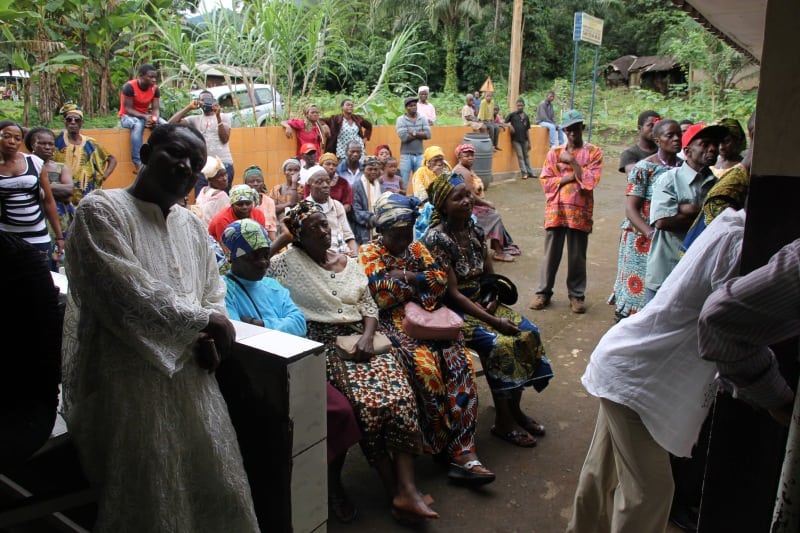
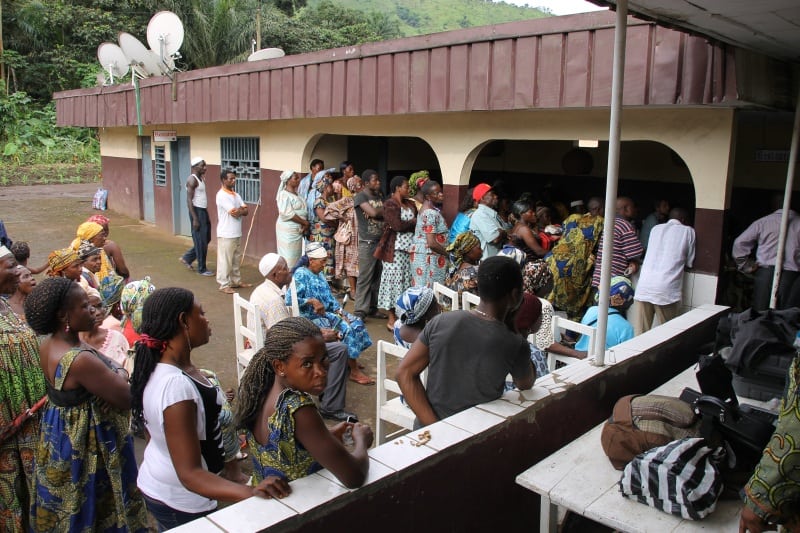
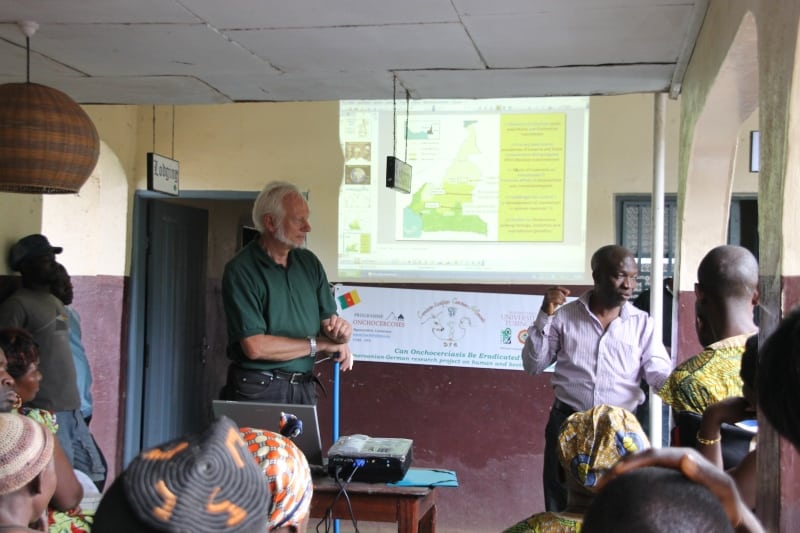
Onchocerciasis-Presentations in the Villages

Teaching in the villages is of paramount importance for onchocerciasis control: To motivate community-directed Ivermectin-masstreatments (APOC), to avoid being bitten by the Simulium vector flies and to wear appropriate protective clothing.

Teaching is much like vaccination: The information (“danger signal”) has to be learned actively by every single person, and is stored either by neurons of the central nerve system or by memory cells of the immune system. The information has to be transformed into action whenever needed: Simulium bites can be actively avoided by clothing and behaviour and microbiotic agents can be eliminated by antibodies or immune-cells. In both cases, infomation is stored for for longtime, but must be boostered from time to time. And both the appropriate behaviour and immunity are not always fully protective. nor is the protective effect quickly visible. This makes both approaches so difficult.

When onchocerciasis-researchers first came into this onchocerciasis-endemic area, there was no treatment available and no larvicide-treatments possible to fight the vectors. The villagers agreed to participate in the medical examinations done by Drs Duke, Anderson and Fuglsang (1974-1977) and by the teams of OCEAC/Centre Pasteur in 1987-2000).

It was in 1987, when we designed the first large-scale field-trial of ivermectin-mastreatment in the villages along the river Vina du Nord. This was the first time, that the villagers benefited from a new drug, that effectively killed the worm larvae (microfilariae) in the skin. Both research and ivermectin mass-treatment largely depends from the good-will and participation of the village populations. This is why information is so important. It was through these oncho-campaigns that the villagers first learned that blindness is not a scourge on the land, but the devastating effect of a minute worm, that they could see under the microscope. And that the adults worms can even be palpated in the subcutaneous nodules. We did such village presentations with the help of a generator and a slide-projector in 1985 and with a video-beamer in 2011. For the villagers, some of even well remembered our visits 20 or 30 years ago, this was a convincing sign, that their participation in research was not en vain.

Onchocerciasis-presentation in the village Karna-Manga, March 2011:
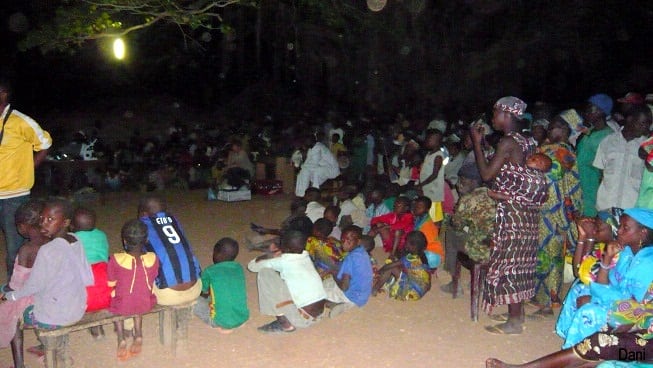
Karna Manga is located near the Benoué river in the Sudan savanna north of Ngaoundéré. It was one of the study villages in 1989-1993, where the epidemiology and cross-transmission of human and bovine onchocerciasis was examined (Wahl et al. 1997)
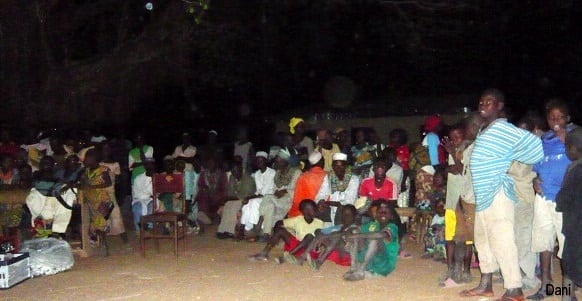
Onchocerciasis teaching in the villages

Oncho-presentations in villages along the river Vina in 1985 (photos Soramboum)

  • History of Cameroon
  • History of Programme Onchocercoses
  • Partners DFG II: COBE 2013-
  • Teaching
    • Organismische Parasitologie (Univ. Tübingen, WS)
  • Partners DFG I: Secretome 2000-2013
  • Gallery
    • Breeding Sites
    • Cameroon Excursion 2014
    • Cattle Work
    • DFG Conferences
    • Fly Work
    • Simulium Fly Traps
  • Contact
    • Press Releases

Recent News

  • Afrika-Festival 2018 in Tübingen
  • Congress of the German Society for Parasitology in Berlin March 2018
  • Sevidzem Lendzele and Archile Paguem back in Tübingen
  • Dies universitatis WS 2017/18
  • Congratulation to Sevidzem Lendzele!
University of Tuebingen

University Tuebingen

Insitute of Evolotion and Ecology

Deutsch
English

Search

Search Search

Categories

  • Donations
  • News
  • Our Project and the Community
  • Press Release
  • Project Partners
  • Uncategorized
© Copyright 1979-2026 Programme Onchocercoses, Dr Alfons Renz - All rights reserved.
  • Legal DisclaimerLegal Disclaimer This website is designed for information purposes only. Whilst every effort has been made to provide accurate and up to date information, it is recommended that you consult us before taking or refraining from taking action based on matters discussed. We accept no liability for any loss suffered as a result of your use of this website or reliance on any information provided on it. The website contains links to websites operated by third parties over whom Programme Onchocercoses has no control. These are provided for your convenience only. We therefore make no warranties or representations as to the accuracy or completeness of any of the information appearing neither in relation to any linked websites or documents nor as to the suitability or quality of any of their products or services. Copyright is reserved to Programme Onchocercoses and to its associated partners (as listed in the partners page) and this material may not be circulated, reproduced or published in whole or in part without written consent of Programme Onchocercoses. You may print articles or material or download them to a local hard disk for your own personal use or use by others within your organisation. You may also…
  • Privacy PolicyProgramme Onchocercoses (“riverblindness.de”, “riverblindness.eu or “we”) are strongly committed to privacy issues, and this privacy statement details our approach on such issues. By using this site and submitting any personal data, you agree to the use by Programme Onchocercoses of such data in accordance with this privacy statement. If you have questions on privacy issues, please email us at info@riverblindness.eu Data collection We only collect identifiable personal data or information that is specifically and voluntarily provided by a visitor to our site. For example, a visitor to our site may choose to provide information such as name, title, office address, office email address and telephone number in order to: ▪ register for certain areas of the site; ▪ contact us for further information; ▪ participate in “join our mailing list” initiatives Visitors are also able to send email to us through the site. Their messages will contain the user’s contact name and email address, as well as any additional information the user may wish to include in the message. Use of data When a visitor provides personal data to us, we use it solely for the purposes for which it was provided to us as stated at the point of…
Scroll to top Scroll to top Scroll to top

This site uses cookies. By continuing to browse the site, you are agreeing to our use of cookies.

OK××

Cookie and Privacy Settings


How we use cookies

We may request cookies to be set on your device. We use cookies to let us know when you visit our websites, how you interact with us, to enrich your user experience, and to customize your relationship with our website.

Click on the different category headings to find out more. You can also change some of your preferences. Note that blocking some types of cookies may impact your experience on our websites and the services we are able to offer.

Essential Website Cookies

These cookies are strictly necessary to provide you with services available through our website and to use some of its features.

Because these cookies are strictly necessary to deliver the website, refusing them will have impact how our site functions. You always can block or delete cookies by changing your browser settings and force blocking all cookies on this website. But this will always prompt you to accept/refuse cookies when revisiting our site.

We fully respect if you want to refuse cookies but to avoid asking you again and again kindly allow us to store a cookie for that. You are free to opt out any time or opt in for other cookies to get a better experience. If you refuse cookies we will remove all set cookies in our domain.

We provide you with a list of stored cookies on your computer in our domain so you can check what we stored. Due to security reasons we are not able to show or modify cookies from other domains. You can check these in your browser security settings.

Google Analytics Cookies

These cookies collect information that is used either in aggregate form to help us understand how our website is being used or how effective our marketing campaigns are, or to help us customize our website and application for you in order to enhance your experience.

If you do not want that we track your visit to our site you can disable tracking in your browser here:

Other external services

We also use different external services like Google Webfonts, Google Maps, and external Video providers. Since these providers may collect personal data like your IP address we allow you to block them here. Please be aware that this might heavily reduce the functionality and appearance of our site. Changes will take effect once you reload the page.

Google Webfont Settings:

Google Map Settings:

Google reCaptcha Settings:

Vimeo and Youtube video embeds:

Other cookies

The following cookies are also needed - You can choose if you want to allow them:

Accept settingsHide notification only